Lower prices for all book in Pdf format
Deep Learning
How to perfect youir learning skills through deep reading!
Beyond the Written Page
Eight Secrets to Help Your Brain Master Knowledge
We have all been there: you reach the bottom of a page, your eyes having dutifully tracked every line, only to realize your mind was miles away. You’ve "read" the words, but you’ve absorbed nothing. As an educational neuroscientist, I can tell you that this "blanking out" isn't a moral failing or a sign of low intelligence. It is a failure of the neuro-biological framework you are using to process data.
Learning is not about the sheer volume of information you consume; it is about how you prime your brain’s architecture to anchor that data. To truly master knowledge, you must move beyond the "mechanical work" of decoding and start "mind-hacking" your own cognitive mechanics. The insights below will challenge everything you think you know about the act of reading, the power of language, and the very structure of your memory.
1. Introduction: The Illusion of Knowing


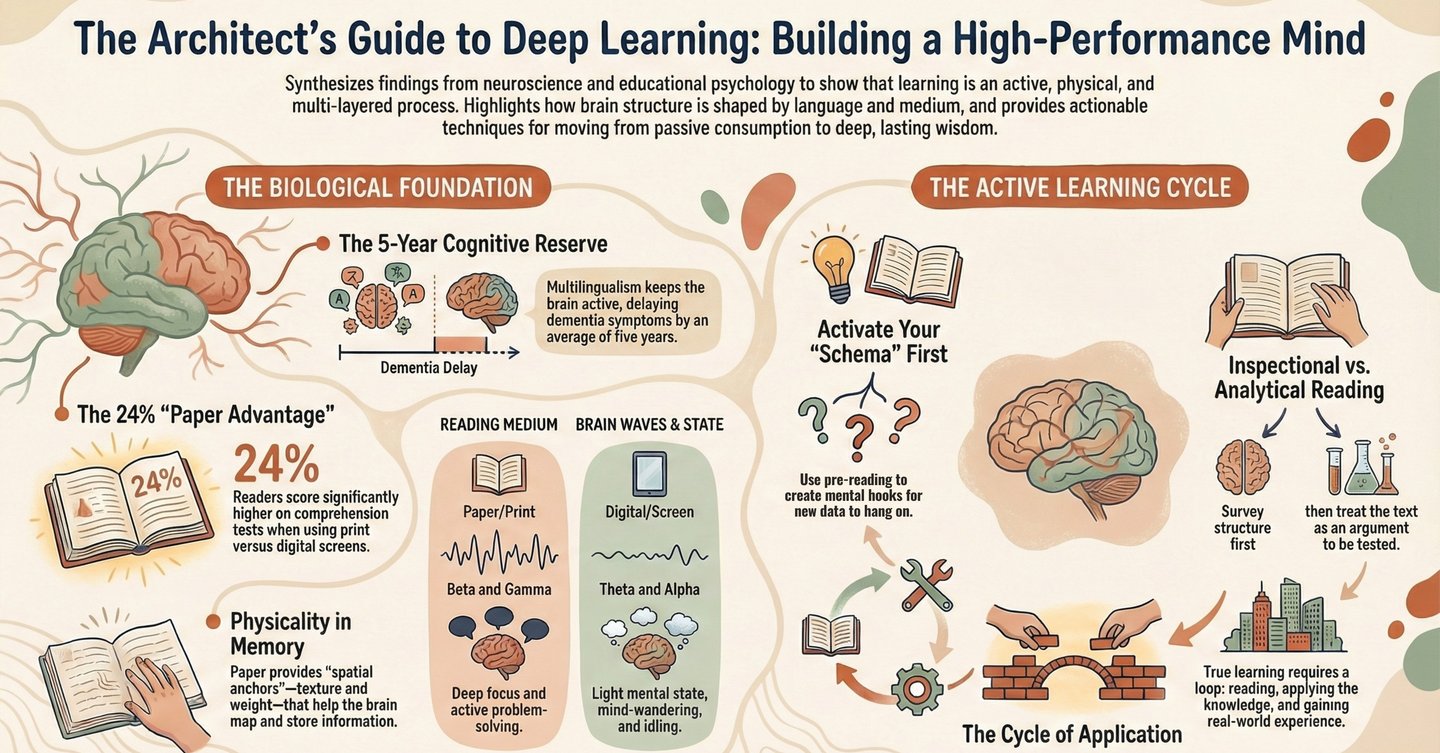
In our world of "infinite scrolls," you might think a screen is just a more convenient book. Neuroscience disagrees. A 2024 meta-analysis of 49 separate studies confirms that print readers outperform digital readers in comprehension by a staggering 24%.
Why? Because of embodied reading. Your brain treats a physical book like a topographical map. It uses "spatial anchors"—the weight of the pages in your left hand versus your right, or a specific concept’s location near a coffee stain on the bottom corner of a page—to index information. On a screen, that dimensionality vanishes. You are left with a "triple whammy" of cognitive interference:
Increased Cognitive Load: Your brain’s "RAM" (working memory) is taxed by managing the scroll and resisting notifications.
Lack of Anchoring: Without physical landmarks, your brain struggles to "place" the data.
The Shallowing Effect: Years of scanning hyperlinks has conditioned your brain for superficial "keyword hunting" rather than deep immersion.
This leads to a metacognitive failure: digital readers often report feeling more confident in their understanding, yet they perform significantly worse on objective tests.
"Digital reading creates an illusion of comprehension and the research shows this gap gets bigger the more complex the material."
When you read on paper, your brain produces beta and gamma waves, the frequencies of deep focus and active problem-solving. On a screen, you often drift into alpha and theta waves—a state of passive "mind-wandering" where your brain is essentially idling.
2. The 24% Edge: Why Your Brain Still Craves Paper


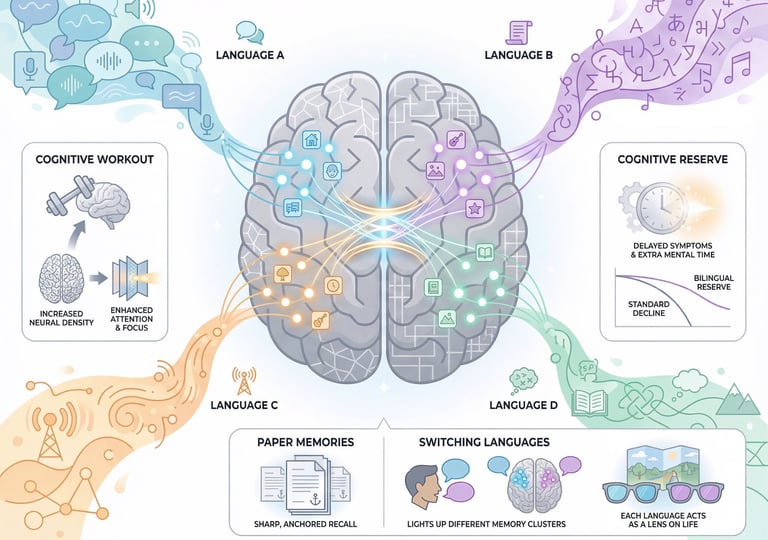
Learning a second language is the ultimate neurological workout. This isn’t about status or education; it’s about the biological density of your "gray matter" and the structural integrity of your "corpus callosum"—the bridge between your brain’s hemispheres.
By constantly switching between languages, you build a "cognitive reserve" that keeps your attentional filters sharp. While this doesn't prevent dementia, it acts as a "time machine," delaying the appearance of symptoms by four to five years.
But here is the truly mind-bending secret: language-dependent memory. Research shows that your memories are "tethered" to the linguistic scaffolding used when they were created. If you study a concept or have an argument in a specific language, your recall will be significantly sharper when you return to that same language. Each language you speak provides a different lens through which your brain encodes your very life.
3. The Multilingual Time Machine: Delaying Brain Aging by Five Years
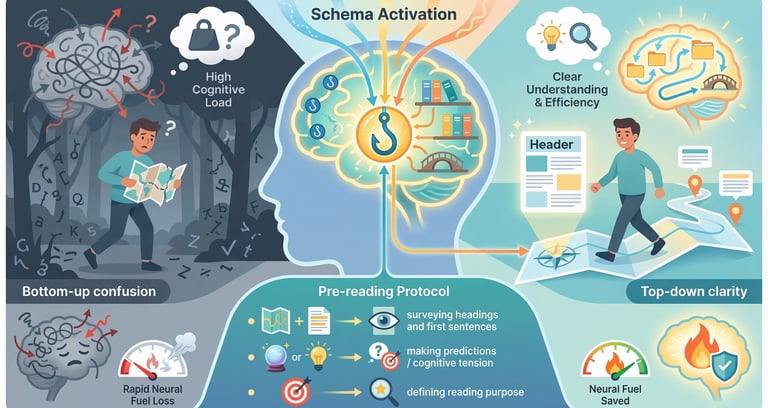
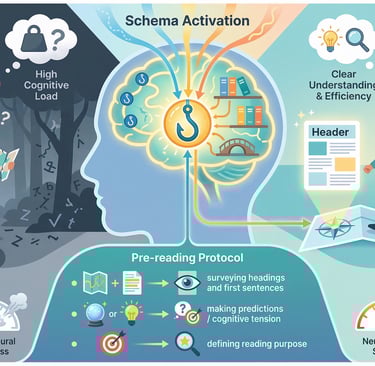
In 1972, researchers Bransford and Johnson proved that a confusing text (like their famous "washing clothes" paragraph) only makes sense if the brain has a "hook" to hang the data on before it begins. This is schema activation.
A schema is the mental framework that allows for "top-down" processing. Without it, you are stuck in "bottom-up" decoding—the exhausting work of trying to build a map while you’re already lost in the woods. To bypass this, use my Pre-reading Protocol:
Map the Structure: Spend five minutes surveying headings and the first sentences of paragraphs.
Make Predictions: Guess the author’s conclusion. This creates "cognitive tension" that your brain will actively work to resolve.
Define Your Purpose: Are you reading to be persuaded or to find a specific fact?
By activating the right schema, you save "neural fuel," allowing your brain to focus on deep reflection rather than mechanical decoding.
4. The 1972 "Hook": Why Context Must Precede Content
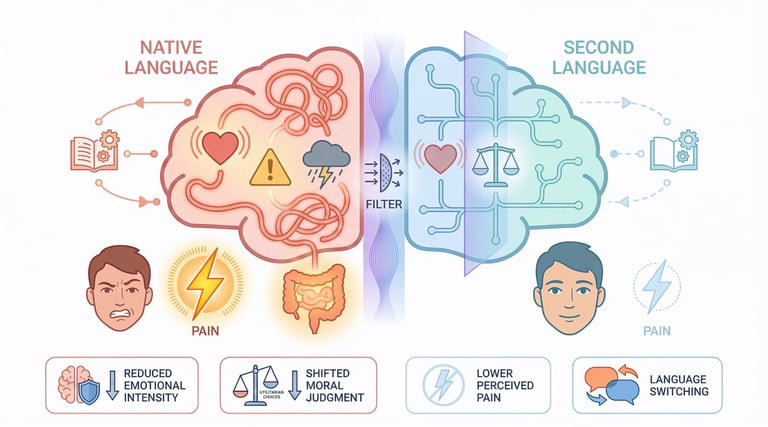
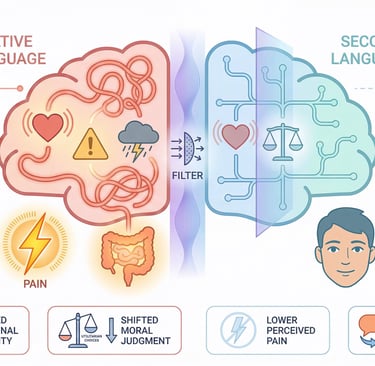
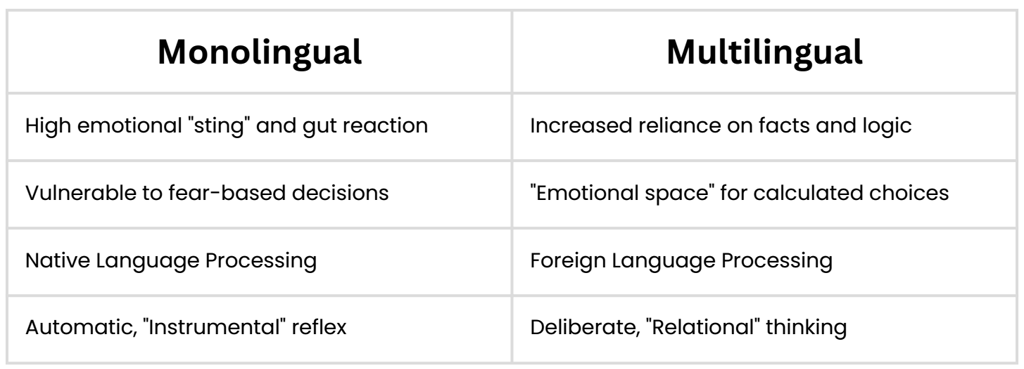
Thinking in a non-native language provides a unique "emotional distance." Because a second language isn't as deeply tethered to the instinctive "gut feelings" of childhood, it acts as a filter that "blunts the edge" of strong emotions.
This leads to a fascinating shift in moral judgment. Studies show that people make different ethical choices—often more utilitarian and less fear-driven—when weighing a dilemma in their second language. This distance even extends to physical sensation; bilinguals often rate pain as less intense when describing it in their non-native tongue.
5. The Emotional Filter: How a Second Language Makes You More Logical
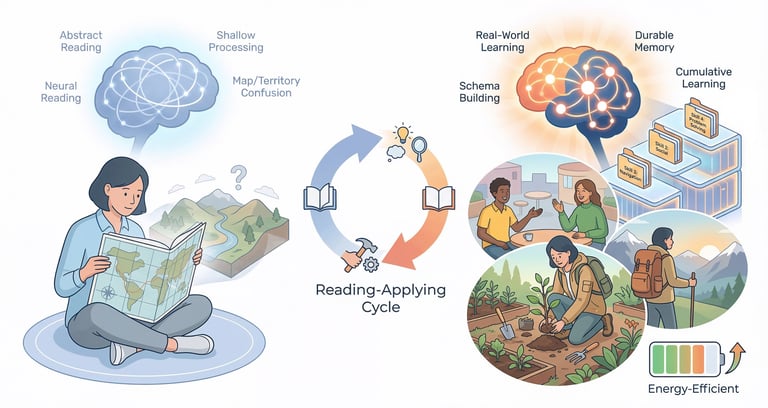
Your brain is hardwired for efficiency, often tricking you into reifying—mistaking the "map" (the book) for the "territory" (reality). To master a subject, you must move from reading to raification: the process of turning theoretical ideas into concrete actions.
True learning requires the "Reading-Applying Cycle." Neuroscience shows that "experiential learning" (like traveling to a new culture or applying a new skill in an uncomfortable social setting) creates entirely different, more durable memory traces than armchair study. This is the cumulative enhancement model: every new skill or language you master expands your library of schemas, making the next thing you learn even easier and more energy-efficient.
6. Reading is Not Learning: The Cycle of Experiential Growth
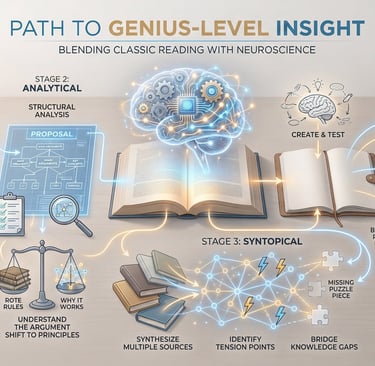
To reach "genius-level" insight, we look to Mortimer Adler’s classic framework, which I’ve updated with modern neuro-biological principles:
Inspectional Reading: Surveying the structure to reduce cognitive load.
Analytical Reading: Treating the book as a "proposal" to be tested. This is the move from Instrumental Understanding (rote rules) to Relational Understanding (knowing both what to do and why).
Syntopical Reading: Comparing multiple works to identify tensions and "schematic gaps."
Externalization: This is the most critical "mind-hack." Don’t use notes as a memory aid; use them to make your thinking "inspectable and falsifiable."
7. The "How to Read Like a Genius" Protocol
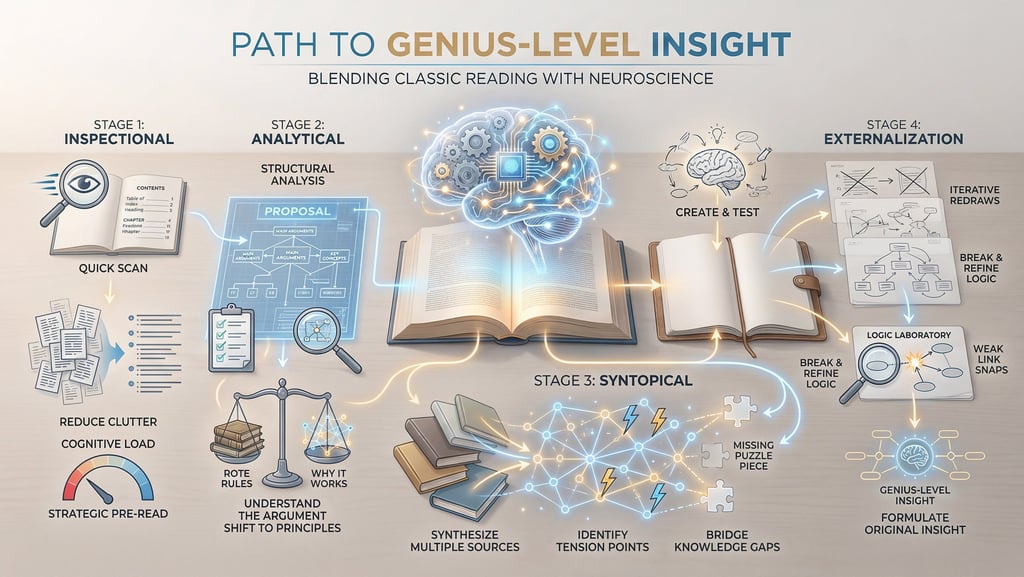
Follow the example of Leonardo da Vinci: his notebooks were full of partial diagrams that he would redraw and annotate repeatedly. He wasn't just recording facts; he was using the page as a laboratory to see exactly where his logic broke down.
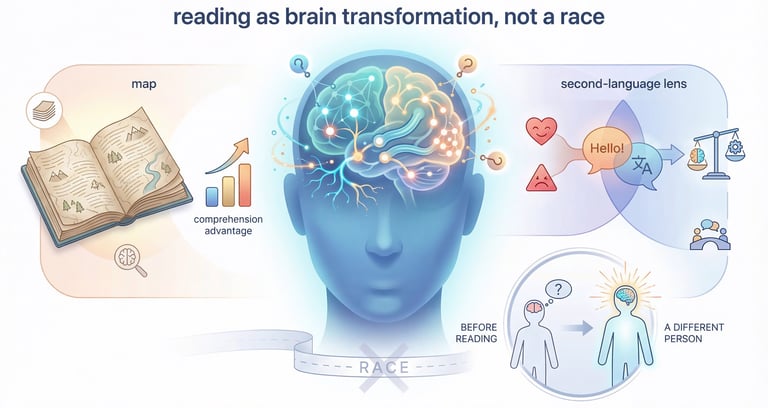
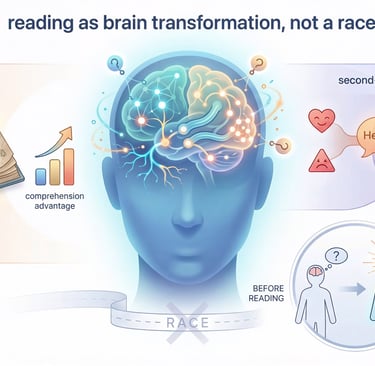
Reading is not a race to a finish line; it is a process of synaptic plasticity and biological transformation. Whether you are leveraging paper for its 24% comprehension edge or using a second language to bypass emotional bias, you are intentionally sculpting your own brain.
The final takeaway: The goal of reading isn't just to get to the finish line; it’s to come out the other side a different person.
Which of these neurological "hooks" will you use to change the way you interact with the next page you read?
8. Conclusion: The Goal of a Different You
Sources
Bargain Books
Explore our website for new and interesting titles.
Contact
booksbyargus@gmail.com
760-904-4601
© 2026. All rights reserved.